
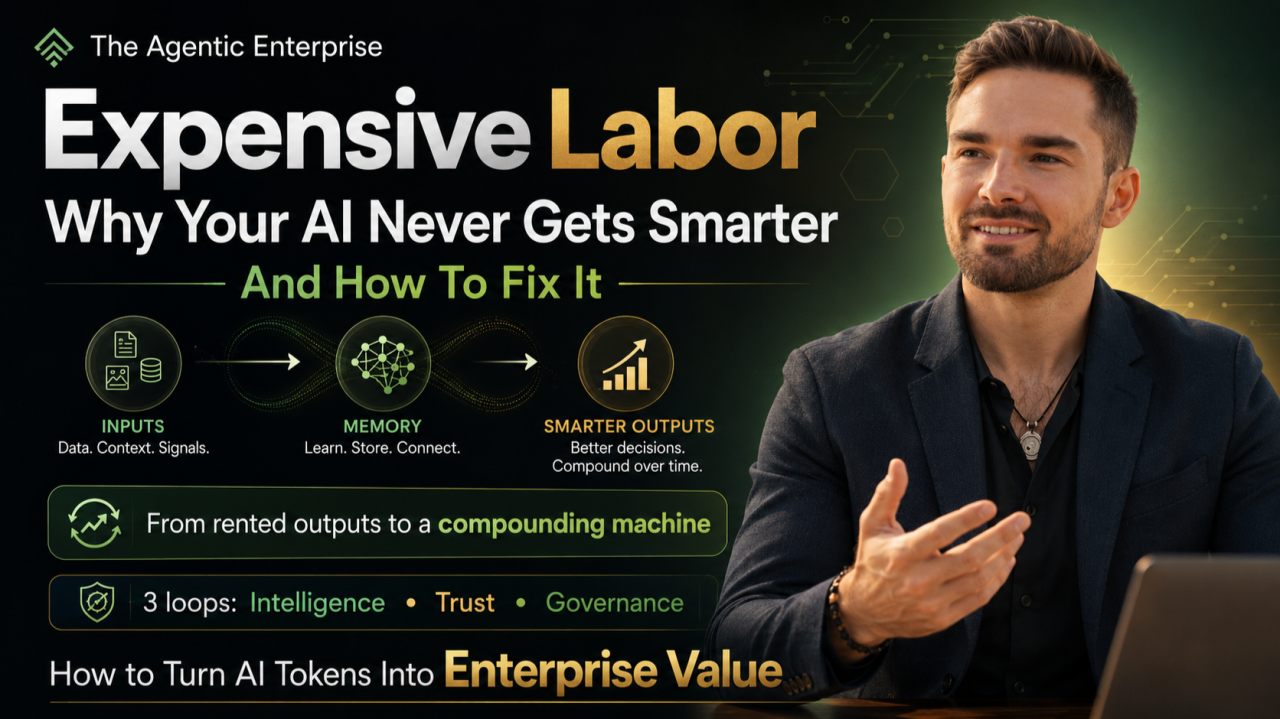
- Most businesses "using AI" run a vending machine: a prompt goes in, an output drops out, and the system remembers nothing - you pay per output for labor that learns nothing.
- A compounding machine is built so every interaction leaves it smarter. The right question isn't "what did the AI produce today?" but "is my business getting measurably smarter every month - and do I own that intelligence?"
- Three loops make it compound: Intelligence (ledger, healers, living memory), Trust (earned autonomy), and Governance (logs, undo, human-on-top). Pull one out and the machine stalls.
- You're not betting on a model, you're building a machine. When a better model arrives, you swap the engine and keep the car - the captured judgment stays yours.
Years ago, I ran a marketing agency. But every single Monday, we started over. Every new client was a blank page. Every campaign was rebuilt from instinct. And every time a talented person left, they walked out the door with the playbook they'd built inside their own head. Sure, we had systems in place - but years of hard-won judgment were gone with two weeks' notice. I used to think that was just the cost of doing business. It wasn't. It was the absence of a machine.
Now that AI leverages the impact of every decision 10-100x, most companies are about to make that exact mistake again - at a much higher price.
The vending machine
Walk into most businesses "using AI" today and you'll find a vending machine. You put a prompt into Claude or ChatGPT, and an output drops out. Tomorrow you put the same prompt in and get a slightly different output - because the machine has no memory of yesterday, no memory of the correction you made, no memory of the result that the last output had.
Yes, it's faster than a human at the task. But if you don't have a mechanism for your AI to learn from the process it's executing for you, you aren't building a repeatable system. You're paying per output for labor that learns nothing. That's not an AI strategy. That's an expensive vending machine.
The business leaders who will win the next decade are asking a completely different question. Not "what did the AI produce today?" but: Is my business getting measurably smarter every month - and do I own that intelligence? That is the difference between a vending machine of tools your team only sometimes adopts, and a compounding machine that multiplies your enterprise value.
Why most AI doesn't compound
Each conversation is an island. The fix you made yesterday is gone today. Until your AI is responsible for the entire workflow rather than receiving separate orders to implement pieces of it at a time, the exception you handled last week has to be re-explained next week. And the genius of your best people is still walking out the door when they leave - except now it's walking out alongside an AI that never captured it either.
That's not a problem you can buy your way out of with a smarter chatbot running a newer model. A machine can only remember into a foundation built to hold the memory. Without that foundation, even the best model is a brilliant temp who quits at the end of every task.
The three loops that make a machine compound
A compounding machine isn't just a smarter model. It's a system built so that every interaction leaves it better than it found it. Three loops turn - and they turn each other. Let me show you each one the way it actually runs inside my own company.
Loop 1 - Intelligence
In my software company, a team of AI agents does all of the software building, and I manage the AI who manages them. I call the managing AI "Cycle," because it operates on an intelligent management cycle over the agents. The thing that makes my agent team compound isn't that they're smart. It's three habits, baked into the machine:
- We keep a ledger. Every time my Cycle agent notices and fixes a problem, the fix is written into a permanent record that the system reads before it does that kind of work again. We don't solve the same problem twice.
- We build healers. When a particular kind of mistake shows up more than once, we don't just fix the instance - we teach the system to catch and correct that whole class of mistake on its own. I call this the "teach to fish" protocol: don't just fix the mistake (give a fish), build a rule that makes that mistake impossible going forward (teach to fish).
- We keep a living memory. Any time I say "no, say it this way," "always do this first," or "this is what we'd never do," the agent captures that insight into a memory placed in front of the AI on every task. Hard rules become the default framing from which all work begins.
That principle is the same in any business. In marketing, instead of one-off prompts across the funnel, the owner-operator has one daily check-in with an AI CRO that continuously self-optimizes the marketing and sales process across every channel. In healthcare, a senior clinician's adjustment to a care plan becomes a rule the HIPAA-compliant copilot applies the next time a nurse practitioner queries the system. In construction, the veteran estimator's gut-feel on a bid becomes a pattern the whole team leans on. In media, the best editor's notes become the standard every other editor instantly benefits from. Write the correction down once, into a place the system reads every time, and it stops being one person's memory and becomes the company's core operating intelligence.
Loop 2 - Trust
None of my agents got the keys to everything on day one. They earned them. New kinds of work start in something like a supervised mode - the agent proposes, I approve and watch carefully. Depending on complexity, it can take about 1-4 weeks to responsibly automate a workflow. As I watch the output, it's a gut feel that tells me they're ready for more autonomy - almost like teaching someone to drive: the moment you feel yourself relax and feel safe with them at the wheel, you know they're ready for more responsibility.
When I feel that drop of peace in my nervous system, I promote that agent to "drive" more of that workflow on its own, and I move my attention to the next frontier. The risky, irreversible things still wait for me. The reversible things run free once they graduate. More delegation surfaces more edge cases - the weird ones, the once-a-quarter exceptions - and each one becomes new fuel for the intelligence loop. Trust is the mechanism that scales the advantage. But not trusting blindly; you're trusting as it earns it, one well-managed workflow at a time.
Loop 3 - Governance
Velocity without control is how companies get hurt. So in my company, every action the system takes lands in a log I can search, and almost everything can be undone. Anything touching money, a customer, or something irreversible routes to a human before it goes out. When something does go wrong, it gets quarantined - not shipped.
Here's the counterintuitive truth: the brake is what lets you go fast. Because I trust the guardrails - the log, the undo, the human-on-top on the things that matter - I can let far more run autonomously than a more nervous operator ever could. Governance isn't the tax you pay for automation. It's the thing that makes aggressive automation safe enough to actually do.
Pull any one loop out and the machine stalls. A system that learns but can't be trusted gets switched off. A system you trust but can't govern eventually scares you into switching it off. But spin all three together and you get something most businesses have never had in their history: an industry-leading enterprise made of workflows that compound effectiveness.
How to start building yours
This works whether you run a clinic, a consultancy, an agency, a manufacturer, or a professional-services firm. You don't boil the ocean. You build one compounding loop, prove it, and repeat.
- Pick one workflow your team does often. Not your hardest problem; your most repeated one - the thing your team does 10+ times a week where quality depends on knowing how leadership would handle it.
- Capture the judgment before you automate anything. Sit with your best person and write down how they actually decide - the rules, the exceptions, the "never do this." This is the step everyone skips, and the one that makes the difference. Structure first, automate second.
- Make the AI read that document every time - and give it a ledger. The AI never starts from a blank page. It reads your captured judgment first, every run, and every correction goes back into the source file it reads before acting. Now you have a loop: it produces, you correct, it gets better, the correction stays.
- Put yourself on top with a simple rule: reversible runs, irreversible waits. Decide which outputs are two-way doors (a draft, a routine reorder - let it run while you spot-check) and which are one-way doors (a clinical decision, a contract, a payment - you approve first). Keep a log so you can always see and undo. That's governance, from day one.
- Promote as it earns trust, then pick the next workflow. Watch your override rate. When you find your nervous system relaxing as you approve instead of fix, let that workflow run more freely - and start the next one.
A quick gut-check to keep yourself honest: how would you know if your AI got quietly worse this week? If the only answer is "a customer would complain," you have a vending machine, not a compounding machine - you're missing the ledger and the human on top. Fix that first.
"But won't this be obsolete in six months?"
This is the fear I hear most: "AI changes every week. If I build now, won't it be obsolete by fall?" It's the right question with a backwards answer. You're not betting on a model. You're building a machine. The models will keep getting better - faster than any of us can track. But when a better engine arrives, you swap the engine and keep the car: the captured judgment, the ledger of corrections, the accumulated intelligence. All of it stays yours and rides on top of the better model.
The people waiting for AI to "settle down" before they start will never start compounding. And compounding is unforgiving to those who begin late. Every month you run a vending machine is a month your competitor's compounding machine gets smarter. That gap doesn't stay a gap. It becomes a chasm.
What lights me up most about this
There's something deeper here than efficiency, and it's the reason I do this work at all. Everyone on your team carries unique genius - taste, judgment, passion, a way of seeing that took decades to earn. For all of history, when they walked out the door, that genius walked with them. A compounding machine, built right, is the first thing we've ever had that lets you honor and keep that genius - not to replace the person, but to amplify them into the more creative role of strategic management, and to let the rest of your team stand on the shoulders of the exponential output.
This is precisely why I believe AI is the best catalyst for liberating human potential in the history of humanity. AI is lifting the heavy blanket off our hearts - carrying the cognitive load so humans can rise to the work only humans can do: the caring, the connecting, the judgment, the taste. Your business doesn't become less like you as it scales. It becomes more like you - your standards, your care, your way of doing things - running at a level you alone could never sustain.
So here's the question I had to sit with myself, and the one I'll leave you with: Are you renting outputs, or building an asset? Renting outputs gets you through the quarter. Building a compounding machine grows quietly into the kind of advantage that can't be bought or copied - and makes your company a far more profitable, sellable, and valuable asset.