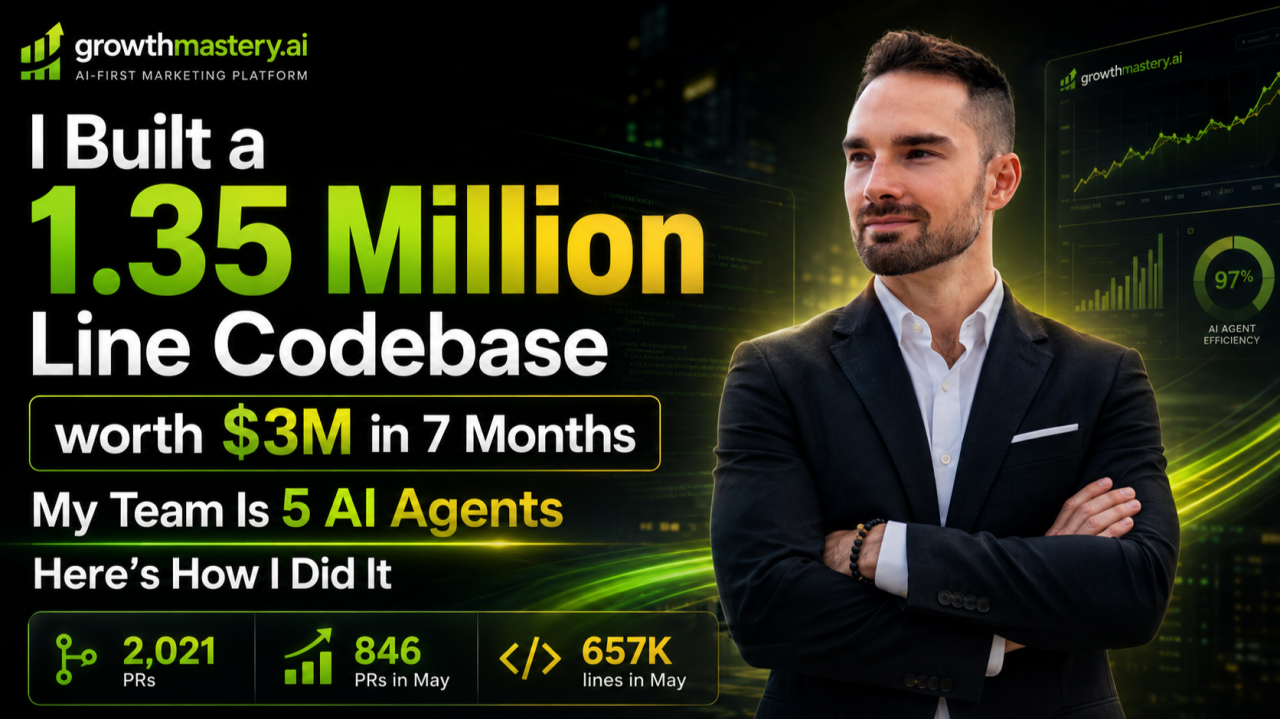
- In 229 days, five AI agents directed by one human produced ~1.35M lines of production TypeScript, shipped 2,021 pull requests, and closed 820+ issues - in May 2026 alone, 846 PRs (27/day) and 657,000 lines.
- The architecture is a five-agent C-suite - Atlas, Sage, Luma, Nova, Prism - where no step is skippable.
- The bottleneck was never the agents. It was my own clarity: every wrong output traced back to an underspecified prompt. Verification had to be engineered in, not assumed.
- You don't need five agents to start - just one well-constrained agent on a real problem, with human judgment at the strategic layer.
It all started when I heard Elon Musk say: "If you want to build a thing, don't build it directly. Instead, build the machine that builds the thing."
At the time, I was (and still am) the Co-Founder and CMO of Abundancia.life, a regenerative community development project. With a launch approaching, I was tasked with creating a webinar funnel for our homebuyers and another for investors. So rather than building two labor-intensive funnels with the clunky software on the market, I took a hard look at Claude Code and asked myself: what if I built my own AI-first SaaS company from the ground up, specifically designed to build the entire automated webinar funnel based on expert best practices at every conversion event?
I had previously run a digital marketing agency called Viral Purpose Media, where I led a team to build conversion-optimized funnels and ad campaigns. But I transitioned out because of all the manpower required to deliver a great, high-converting funnel. The pre-AI agency model forced me onto a services hamster wheel and to charge far more than many of my clients could afford. But my mission still sang in my heart: to liberate human genius by helping entrepreneurs share their gifts with the world. So I went for it.
The fork in the road
In October 2024, I bought the domain GrowthMastery.ai and started laying the foundation with my technical cofounder Dan. We made progress, but I quickly found inefficiency in translating my specific customer-requested vision through a human developer into working code. By November 2025, 200,000 lines into an only partially-functional prototype, Dan told me he was going to pursue other opportunities.
I had three choices: drop the project, find another cofounder, or pick up the flag and march on with the mission myself. Fueled by my mission - and ignorant of the complexity ahead - I chose option three. Dan and I parted ways as friends. I created a fresh GitHub repository, imported our foundation, and began building day in and day out.
But it wasn't as easy as just describing the platform into Claude Code. I tried that, and found the context size of a full-blown done-for-you agentic marketing platform far too large for any one terminal window, even running for days. The first pass was never deep enough, even with the latest model. I realized I needed a team of C-suite experts iterating, innovating, testing, planning and building 24/7. So I built one.
The numbers, plainly stated
Today - 229 days later - that repository contains roughly 1.35 million lines of production TypeScript. It has shipped 2,021 pull requests and closed 820 issues. In May 2026 alone, my agent team merged 846 pull requests (27 per day) and wrote 657,000 lines of customer-ready code.
- Repo age: 229 days
- Lines of TypeScript: ~1.35 million
- Total PRs merged: 2,021
- PRs merged in May 2026: 846 (27/day)
- Net new lines written in May: 657,000
- Human contributors: 1 (me)
- Traditional team equivalent: 5-8 engineers
For context: a team of 5-8 human engineers without AI would generate maybe 5 PRs per day and 250-1,000 lines/day. Luma wrote, shipped, tested and verified 20,000 net new lines per day in May. Every day. All based on what real users were requesting in the platform. The product is GrowthMastery.ai - an AI-first marketing platform used by dozens of entrepreneurs to save $50K+ of agency costs. We launched in December 2025 to a beta group, and with strong traction, valuation estimates range from $3M to $5M - and we're just getting started.
The architecture: the Atlantean Command
Five AI agents, each with a locked-down role:
- Atlas (me in AI form - CEO/CFO logic) evaluates everything coming in against a 7-filter strategic framework. When I message an idea on Telegram, Atlas prioritizes it, decides if it's worth building, and dispatches it downstream. Revenue-blocking issues get auto-dispatched without my input - that's the policy.
- Sage (COO + Design Lead) receives every task from Atlas before it hits engineering, adding design direction, operational context, dedup checks, and compliance. No feature bypasses Sage - a rule learned the hard way after a double-dispatch incident created two conflicting PRs for the same feature.
- Luma (CTO & Engineering) takes Sage's specs and ships production code: pull requests, test coverage, TypeScript, SQL migrations, no build errors, no merge conflicts - the whole stack. In May 2026, Luma averaged 27 merged PRs per day, because I parallelize the pipeline so the agents clone themselves up to 6 times for 6 channels of work at once.
- Nova (Revenue/Marketing) runs experiments, writes copy, handles GTM, and ensures features are built with minimum user friction. She operates separately from engineering because the incentives differ - but her CRO perspective in planning every feature creates remarkably well-considered specs.
- Prism (Chief AI Officer / meta-agent) reviews the other agents every day: routing anomalies, cost per PR, token efficiency, pattern violations. Prism is the layer that makes the system smarter and more efficient without me auditing each agent manually.
What surprised me most
1. The bottleneck was never the agents
I expected to be limited by model quality or context windows. The actual bottleneck was my own clarity. Every time Luma shipped something wrong, the root cause was an underspecified prompt or an ambiguous protocol. The agents were perfect at executing what I specified - and perfect at executing what I didn't specify, which sometimes produced creative and wrong results. The fix was self-awareness: when you're beating your head against the same problem, step back and ask how to empower AI to act inside the workflow you're trapped in. Once I built a protocol that had the agents deliberate on a comprehensive feature plan around any idea I fed them, I got promoted to the strategy layer while world-class CEO, COO and CRO agents handled tactical planning flawlessly.
2. Verification had to be engineered in, not assumed
Early versions reported things as complete before they were verified. A merged PR doesn't mean a feature is customer-ready; a green test suite doesn't mean the user flow works end-to-end. I had to build a post-merge E2E walker - a separate step that walks real user-facing URLs and tests downstream interactions before anything gets marked "done." Without verification as a first-class system component, you get confident agents reporting wrong things. That's worse than slow agents reporting accurately.
3. Speed creates new failure modes
At 27 PRs/day, the failure modes aren't the same as at 2. Merge conflicts compound. Stale context in one agent creates cascading wrong assumptions downstream. The system needed a single source of truth - a dispatch manifest - that every agent reads and writes to, so no agent operates from stale state. It's just a JSON file. It's not fancy, but it is the most important file in the repository.
The economics
Running five production agents on the latest models consumes about 3 Claude Max accounts of tokens per week at $200/month each. Vercel runs about $100 on a heavy build month. My virtual machine is $200/month for 32GB RAM. GitHub adds about $50 for extra actions when I'm building heavily. Compare that to the alternative: a founding engineer in a major market runs $180K-$250K/year before benefits or equity. A 5-person human team is $900K-$1.25M/year in labor alone, before management overhead, onboarding, PTO, and the probability that two of the five won't work out. My fleet ships 27 PRs/day; that human team would ship maybe 5 - at a fraction of the cost, with no off-days and zero ramp-up. The ROI math is straightforward. The genuinely hard part is building systems reliable enough to trust agent output with your business.
What I learned that I didn't know 7 months ago
- The pipeline matters more than individual capability. The forcing function of Atlas → Sage/Nova → Luma, where no step is skippable, beats any single agent being 20% smarter.
- Human judgment belongs at the strategic decision layer. My job shifted from driving every PR to loosely describing the features users would most love, and verifying the outputs.
- AI is here to promote the self-aware and terrify the ignorant. Get humans out of the execution layer and promote them to management and quality assurance over a team of agents.
- Speed without verification is liability. Every "done" claim needs a source. Every status answer needs a live check, not a memory retrieval.
- Specificity is compounding leverage. Vague instructions produce vague outputs; comprehensive plans produce excellent ones - and well-directed agents create the best comprehensive plans.
Who this is for
If you're a founder building with a team, responsible for AI transformation at a company, in marketing or product and told to "add AI" without clarity on what that means structurally, or an engineer trying to beat AI at its own game - the principles here transfer. You don't need five agents or a million lines of TypeScript to start. You need one well-constrained agent on a real business problem, and a genuine willingness to make your instructions precise enough to be executable. Since writing this, I've adapted this autonomous suite of agents to work for all types of businesses - not just software companies - creating a safe, easy-to-manage execution layer that promotes every human in the organization into a creative strategist.